Thursday, October 28, 2010

Fracking: Taking Pennsylvania by Storm

I’m relatively new to the world of hydraulic fracturing, or fracking as it’s more commonly understood. While I’ve, for some time now, been aware of the mining procedure that uses highly pressurized and chemically laden water for extracting underground pockets of oil and gas, my recent summer trip to Pennsylvania’s Lycoming and Clinton counties came with a first-hand encounter with what were soon-to-be fracking sites. Born and raised in PA, I’ve long since found another place to call home. Yet, there is never a day that fails to find my heart yearning my body back to my friends and family still living there today. So, for me, the damage caused by fracking is personal.

Whether you're an environmentalist, hunter, animal rights activist, or just plain tired of industry interests driving politics, the damage done by fracking SHOULD be an issue that unites us all. Fracking’s human and environmental casualties include toxic and highly flammable drinking water, bubbling rivers best reserved for science fiction stories, and massive water consumption tabs. Even at an untrained glance, these casualties seem as the obvious consequences of a process that injects into the earth millions of gallons of water, mixed with diesel fuel, benzene, hydrochloric acid, ethylene glycol and many more nefarious substances, with enough pressure to fracturing shale formations, only to releases natural gas in underground regions close to water our tables. Much of the damage is also caused by poor regulation. For example, while subject to negotiation, PA oil and gas mines can be drilled as close as 100 feet from a stream or wetland and 200 feet from a house. PA state law requires operators to “restore” land within nine months of drilling completion. However, little is actually known about the total costs incurred by the environment due to fracking and most of the known damage cannot possibly be restored in this period.

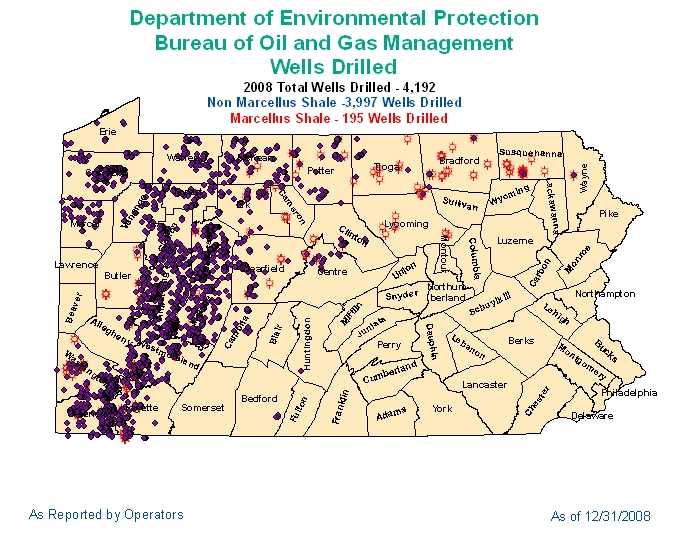
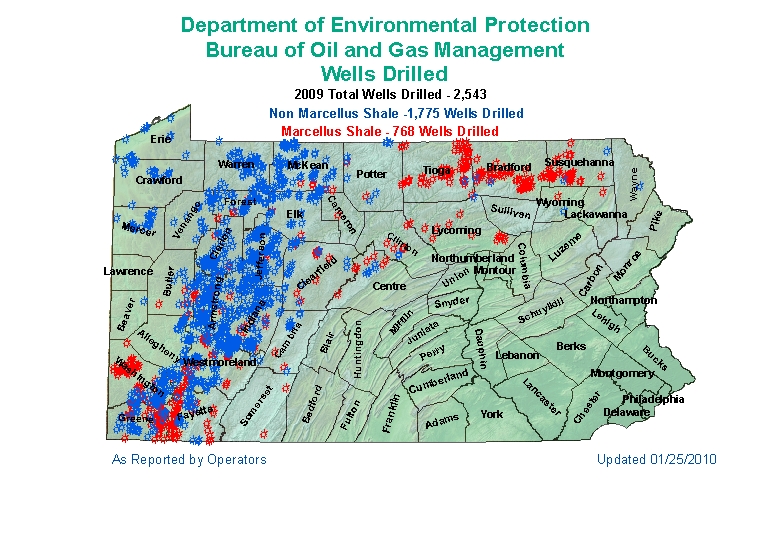
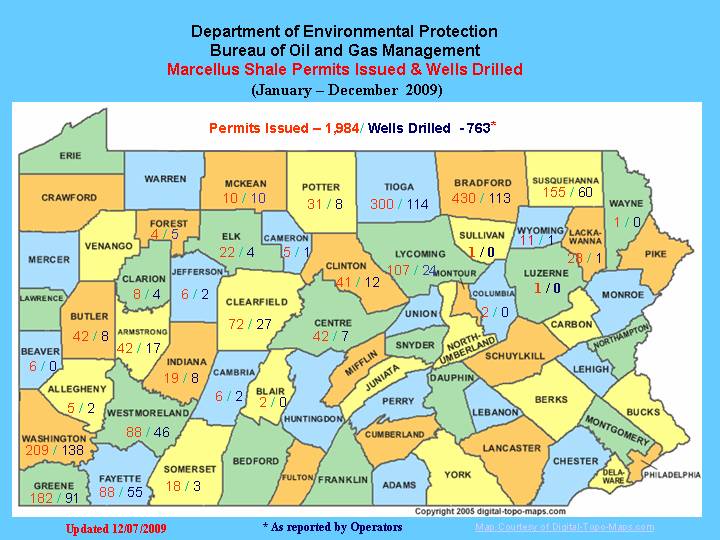
Aside from the executive order recently signed by Governor Ed Rendell that prevents further leasing of state forests for Marcellus drilling, fracking is still scheduled to take PA by storm, along with its wealth of wilderness. According to the State’s Department of Environmental Protection (DEP), some 195 Marcellus shale wells were drilled in 2008 and another 768 in 2009. So far, in 2010, 1099 wells have been drilled. As depicted in the bar chart below, in 2008 there were approximately 20 non-Marcellus wells drilled for every Marcellus well. In 2010, that ratio is close to 1 Marcellus well drilled for every non-Marcellus well. In 2009 alone, some 1,984 Marcellus drilling permits were issued. In 2010, that number rose to 2,350, with a staggering 27% of those located solely in Bradford County. In total, there are currently 74 Marcellus well operators in the state, sitting on whopping 5,591 drilling permits.

Now, keep these numbers, along with this map, in mind as you browse through the following relatively innocuous-looking pics. These pictures were taken courtesy of my awesome parents during their more recent trip to Lycoming and Clinton counties. While these pictures depict the scale of a few isolated fracking sites, multiply this by the state-wide drilling trends or in context of this drilling site map. The captions in italics were written in an email from my Mom.


This (the next two pictures) is a site they were clearing back in August. They now have pipes laid and are getting ready to drill. The rig is not set up but they have the water and whatever else they are using stored on the site pad. These containers as well as other 18 wheeled tankers and stone trucks are hauled up the mountain by the hundreds every week. It is very hard to get people to believe how much traffic is on the roads is to see this for yourself.

Most of these containers weigh more than the roads are rated for. The companies just pay the fine and continue on. Some of the drilling rigs have been weighed at 170,000 lbs. None of these roads are rated for more than 70,000. Most are less than 20,000 rated. This is the kind of money and power these gas companies have.

The other sad part is the laws that allow the fines to be paid and they can continue on 100,000lbs over weight. This is common practice in the state of PA when big companies need to move big stuff. Just pay the fine and move on.


This is what the site pads look like. They usually cover several acres, looks like a Walmart parking lot!


These (next two) are pics of the gravel road, showing how much has been cleared for pipes. The second pic is what this road looked like before the gas drilling. I don't know if they will continue with clearing and drilling along this road or not. This road leads to another vista. We are not sure if the third vista is gone or not. Everything is so messed up we couldn't figure out where the other vistas are or were.


Another pic of land clearing and pipelines.


These next two were taken back in August on Queens Run Rd. Remember when we drove back toward (sorry, no personal names given here) camp last July and we saw the roadway being paved?

They were drilling a month later. In most of these places they reconstructed roadways or made new roads, so you can't get your bearings of where you are. For 25+ years we knew the area so well we knew every turn, now we just wonder where we are. This was such a beautiful gravel road.


The next picture is about a 7 mile part of Queens Run road that so far has not been touched by gas drillers. I really hope they do leave this alone. I would be so sad if they destroyed this beautiful piece of nature. This road follows Queens Run and any alteration to this road would be the end of this pristine stream and the wild life that surrounds it. This road has steep hills on both sides, one side straight up and one side is straight down. Sometimes you have to move downed branches or trees to pass through the road.


Next we have the drilling sites in Tiadaghton State Forest. One is currently being drilled and a lot of land cleared for pipelines. Site storage and drilling pads and future sites being cleared.


The two below are more of the same Rig. I also have one with the sign Bull Run Vista. We used to go to this vista. This site is accessed through what locals call Springer Farms. There is, was, a total of 3 vistas. I am assuming the access to the vista is destroyed and is gone forever. This was very remote and so quiet and peaceful. Now, not so much.


Thursday, October 14, 2010

Fracking up our Water, Here, There and Everywhere.

A blog post contributing to Blog Action Day 2010

Led by some America’s most daring and outspoken individuals and civil society organizations, the assault on America's drinking water and pristine rivers perpetrated by poor regulations and single-minded energy companies is gaining some attention in the media and traction in public discourse. Fracking, or hydraulic fracturing, is one of the industry’s leading and most destructive methods for extracting natural gas from the Country’s enormous patches of shale. Indeed, for anyone motivated into action by water pollution and safe drinking water shortages, fracking needs to be on your radar. By fracturing underground rock formations with high pressured fracking cocktails of water and other substances, fracking’s human and environmental casualties include toxic and highly flammable drinking water, bubbling rivers best reserved for science fiction stories, and massive water consumption tabs. Even at an untrained glance, these casualties seem as obvious consequences of a process that injects into the earth millions of gallons of water, mixed with diesel fuel, benzene, hydrochloric acid, ethylene glycol and many more nefarious substances, with enough pressure to fracturing shale formations, only to releases natural gas in underground regions close to water our tables.

For those of you less familiar with fracking, I direct you to this easy to understand infographic and this truly amazing, but brief video illustrating one of the many hazards posed by hydraulic fracturing. For those more fracking literate, all of this probably seems to be a repeat of what’s been said and read by us thousands of times over. However, what’s often missing from the fracking attention is an appreciation for the global implications of hydraulic fracturing. Indeed, fracking is not only offending America's water wells, rivers and wildlife. It’s poised to make a potentially catastrophic assault on life-sustaining waters on every continent across the globe. While the estimates on the global volume of shale reserves are "highly tentative" (Guler 2010), national security and energy inspired exploration initiatives are popping up places like China, India and Germany to name a few. The Brisborne Herald reports that the Canadian-based TAG Oil Ltd. will frack should it decide to exercise its permits for oil and gas exploration on New Zealand's East Coast (2010). In Australia, Beach Energy is already operating vertical gas wells and is now looking to run fracture simulations and possibly begin drilling as early as 2011 (World Oil News 2010).

The greatest dangers posed by fracking are perhaps found in those countries where a combination of factors, like weak and corrupted regulatory institutions, poorly endowed civil societies and mysterious and untimely accidents occasionally finding outspoken critics, coalesce to undermine the public’s capacity to hold energy interests and governments accountable. In countries like Poland and Bulgaria, where the government’s capacity to adequately regulate powerful interests is far weaker than those found in Western Europe and the North America, one might safely predict that fracking will likely result in human and environmental casualties far greater than those found in Pennsylvania’s mountains and Wyoming’s range lands. And, these very same countries are now shaping up to be some of the new frontiers for shale gas mining operations. A Carnegie Council article entitled "Shale Gas Goes Global" reports that "Poland's shale formations are currently under exploration by ExxonMobil, Chevron, and several other U.S. companies". In fact, earlier this year, Halliburton performed Poland's first-ever shale-based fracking operation (PennEnergy 2010).

The environmental and human tragedies found in the oil-rich Niger Delta are the horror stories in an all too real marriage between a weak and easily corrupted state and global interests driven by profit maximization and national energy security concerns. And companies like Halliburton, Shell and BP are currently scouting out the African Continent for opportunities for another round of resource plundering, but this time it’s shale gas. In an ominous line fit for the lips of Dick Cheney himself, Halliburton reports that, in the Middle East and Africa, "extensive studies are underway to develop execution strategies for the maximum shale operation profitability" (2010). In Tunisia this year, the Canadian-based energy exploration company Cygam Energy Inc. executed two of North Africa's first-ever shale fracking jobs (OGJ 2010). Energy companies are also looking to the massive shale formations that lay beneath the arid Karoo region in South Africa, an area already stressed by acute water shortages (Capazorio 2010). Home to South Africa's lucrative coal mines, five companies, including Shell, Falcon and Sasol, have been issued licences to scout Karoo's shale for economically viable sources of gas (Du Plessis 2010). And, despite assurances from energy companies about their commitment to preserving sources of potable water, many residents rightly fear that gas drilling means 'fracking up' their drinking water.

While the ANC government in South Africa is a far cry from the corrupted basket case that presides over the Niger Delta, fracking chemicals and gas seepages from gas mining in countries like Congo-Kinshasa, Sudan and Somalia will undoubtedly kill what might be an uncounted number of people. What’s more are its implications for the supply of clean drinking and washing water in areas of the world where safe water is already a rarity of life. This same scenario applies to other parts of the world, including the Middle-East, Asia and Latin America, where water scarcity is acute and governments easily subdued by the deep pockets that accompany foreign energy and national security interests. It is incumbent upon us, in our advocacy and our consumption habits, to gaze beyond our borders and do what we can to protect our waters here, there and everywhere.

Sunday, October 10, 2010

Act Now to Stop this "Fracking" Insanity!

Fracking, or hydraulic fracturing, is the process of extracting natural gas by fracturing underground rock formations through a highly pressurized and toxic cocktail of water, diesel fuel, benzene, hydrochloric acid, ethylene glycol and many many more nefarious substances (see Earthworks for more details). Mother Nature Network provides an easy to understand infographic of the fracking process.

While rising natural gas prices buoyed by increased demand for alternatives to coal and oil explain part of a recent scramble by energy companies to extend frack operations throughout many corners of the U.S. and elsewhere, legislation passed by Congress back in 2005 has effectively meant that energy companies can frack without having to comply with even the most basic environmental standards, most notably those falling under the Safe Drinking Water Act. One estimate cites that "hydraulic fracturing is now used in about 90 percent of US gas and oil wells."

Indeed, the human and environment casualties of fracking, as documented by Josh Fox in his ground breaking hit documentary entitled "Gasland", include heavily toxic and highly flammable drinking water and rivers. These human and environmental costs mean that it's time for us to start pushing and signing petitions to ensure that, at the very least, fracking operations cease until measures of sanity are introduced to the regulatory frameworks for ensuring that gas mining is safe for humanity and the environment. To this end, the list below contains some crucial petitions for you to sign and do your part for safeguarding America's waters from fracking fluids and gas.

Please, additional petition suggests are welcomed.

Stop fracking our lands and fracking up our water!

Care2 petition: Stop All U.S. unregulated natural gas drilling.

Act.ly petition (Twitter account needed): Tell Governor Paterson (NY) to ban gas drilling the Catskill and Delaware watershed.

Sierra Club petition: Stop drilling in National Parks.

Sierra Club Atlantic Chapter petition: Protect New York from horizontal hydrofracking.

Care2 petition: Ban natural gas drilling in New York State.

New York Working Families: Tell state Senators to pass a moratorium on hydrofracking.

Put an end to energy industry privilege!

Act.ly petition (Twitter account needed): Tell Lisa P. Jackson to ensure that Halliburton et al. is not represented on fracking study.

Natural Resources Defense Council: Tell Congress to close the "Halliburton Loophole".

Stop prioritizing trade secrets over human rights and health!

Change.org petition: Tell Halliburton to reveal its fracking chemicals to the public.

Saturday, April 3, 2010

More Tea Party Racism?

Lately, I've been browsing some conservative discussion threads collecting some information on how U.S. conservatives use the term "cockroach" to describe liberals. The topic is interesting to me personally, as I've done a fair amount of research on the Rwandan genocide, where talk radio and the "cockroach" metephor went hand in hand.

Tonight, I had an insighful find on the Tea Party Patriots feed posts, where someone was acussing Obama of "invading" his "television with messages that made [his] daughter pregnant with a Puerto Rican Negro baby".

Another post is just as vitriol: "Liberal cockroaches are knocking up our virginal white daughters by advertising on Craigslist. That's how my daughter came to bear a Puerto Rican baby. I blame communist Obama and the permissiv for my daughter's failure to keep her legs closedeness of this liberal government".

Wow! I wish I were suprised by this find. I'm really not sure if these posts are a joke. I'm afraid I'd actually have to sign up as a Tea Party Patriot member to find more details. :-(

Here's a link to the page. Scroll down to the bottom to find all the posts. http://www.teapartypatriots.org/Members/VoiceOReason

Thursday, February 18, 2010

Join World's Longest Toilet Queue and Ask Alyssa Milano to do the Same

A few days ago, I wrote an Act.ly petition, asking Alyssa Milano to stand against sanitation poverty by joining the World's Longest Toilet Queue. Needless to say, we're still waiting for her to join. Below is a copy of the petition, which describes why the Toilet Queue is important. Please, make sure you join the Queue here: http://www.worldtoiletqueue.org/eng

Also, ask Alyssa to do the same by
  • tweeting this: petition @Alyssa_Milano to Stand with Us in World's Longest Toilet Queue http://act.ly/1ph RT 2 sign #actly #WaterWednesday
  • Or clicking here: http://act.ly/1ph

Summary

Some 2.5 Billion people around the globe lack access to improved sanitation. This petition asks Alyssa Milano to please stand with us in demanding world leaders to take action against sanitation poverty by standing with us in the World’s Longest Toilet Queue.

If you have not yet joined the Queue, take 5 minutes now and stand with us. Join the Queue! >>> http://www.worldtoiletqueue.org/eng

Petition

Dear Alyssa Milano;

We admire your unwavering commitment to helping people throughout the global find access to clean water. As you are undoubtedly aware, access to clean water and access to proper sanitation are deeply connected development issues. Unimproved sanitation, such as pit latrines, hanging latrines, bucket latrines, and open defecation, often results in the contamination of water supplies vital for washing, bathing, and drinking. As described vividly by the World Health Organization, “Without improved sanitation, people suffer from ill health, lost income, inconvenience and indignity.”

The figures on the breadth and consequences of unimproved sanitation are shocking. According to UNICEF, nearly 50% of the developing world’s population, or 2.5 billion people, lack improved sanitation facilities. According to the World Health Organization, some 18% of the global population practice open defecation. UNICEF reports that globally each week about 42 thousand people die from diseases as a product of low quality drinking water and poor sanitation. UNICEF also reports that 4000 children die every day from diarrhoea caused by unclean water and poor sanitation.

Moved by the hope of ending sanitation poverty, End Water Poverty (EndWaterPoverty.org) is organizing a series of events in the lead up to World Water Day (March 22, 2010) and the High Level Meeting on sanitation and water (April 23, 2010). Those events include The World’s Longest Toilet Queue, a virtual place for folks like us to demand our world leaders to help end unsafe sanitation. Therefore, we kindly ask you Alyssa Milano, to take 5 minutes and join stand with us in the World’s Longest Toilet Queue, because 2.5 billion people can’t wait any longer.

>>>>>Join the Queue!>>>>> http://www.worldtoiletqueue.org/eng

More information, visit www.endwaterpoverty.org


Thursday, February 11, 2010

Footage from 22 Bahman

Today marked the 31st anniversary of the Iranian Revolution, an event which overthrew the rule of Shah Mohammed Reza Pahlavi. Over the past 31 years however, rule under an Islamic Republic has revealed patterns of brutality not unknown during the Pahlavi days. This has been especially true since the 2005 election of hardliner conservative Mahmoud Amandinejad. This brutality, along with his rigged re-election in 2009, served as the flash point for the Green Movement and the countless masses of Iranians that rose to the occasion today to protest the regime. This article, entitled Iranian Opposition in Standoff with Regime, provides a nice analysis of what was at stake today.

Personally, I have nothing at stake in these protests. I'm not Iranian, nor do I have family and friends living in Iran. However, I believe that human rights, including the right to protest, the right to vote, the right to speak, and a list of other rights, are universal. In other words, the sanctity of these rights are not halted by state boarders, nor are they to be allocated according to race, religion, or creed. To honor that belief, and to those brave Iranians that put their lives on the line for citizen empowerment, I thought I'd post links to some of the most notable video footage to arise thus far out of Bahman 22, or literally the 22nd day of the 11th month of the Persian calender. Later today, I'll be tweeting each of these videos. While not all of the videos are of great quality, all capture a slice of the atmosphere that transpired today. Please watch and remember that a human rights violation in Iran is a human rights violation against us all.

Please, if there are any videos you think are missing from this list, post a comment or drop DM me on twitter @stunetii.

Vid 1: Tehran Protesters throw rocks

Vid 2: Plain clothes police among Protest
Vid 3: Protesting in Tehran Metro Station
Vid 4: Protesting Inside Tehran Metro
Vid 5: (CNN) Iranian Demonstrator Unafraid
Vid 6: Propaganda Machine-Western Leaders are Stupid
Vid 7: Gas and Copters
Vid 8: Chanting down the Regime
Vid 9: Crowds and Copter
Vid 10: Patrons & Clients-Regime Supporters Getting Food
Vid 11: Ripping down Khamenei/Khomeini
Vid 12: Violence-The Regime's Recipe 4 Rule (good quality)
Vid 13: Riot Police Enter the Sadeghyeh Sq.
Vid 14: Karroubi among Protesters
Vid 15: Security Forces Throwing Tear Gas
Vid 16: Free Political Prisoners